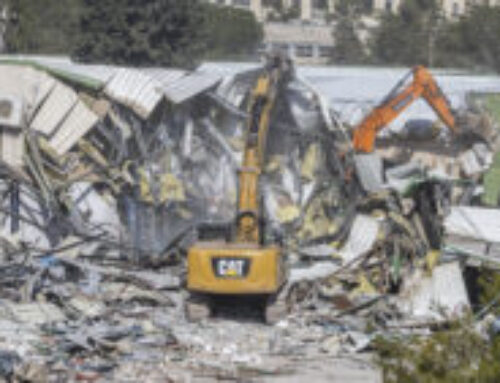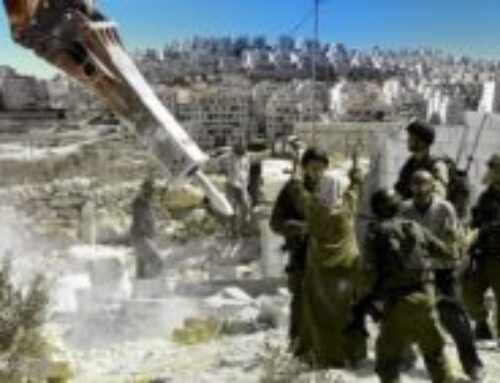
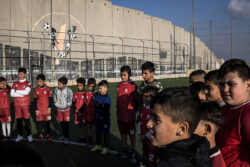
In a narrow corner of the occupied West Bank, just a stone’s throw from the separation wall, children of Aida Refugee Camp have long grown accustomed to chasing a small ball across a modest asphalt pitch, unfazed by the towering concrete that encircles the place. Despite its simplicity, the field represented a rare window to air and dreams in a densely populated camp north of Bethlehem. That fragile refuge was shaken when a decision by the usurping entity emerged to demolish the facility—an act that seemed to target the last remaining breathing space before targeting the structure itself.
A Space of Hope in an Overcrowded Camp
The pitch was never just a place to play; it was a space where dreams and life paths took shape. Abdullah Adnan, a player for the Palestinian national football team, says the field genuinely gave him the ability to train, adding: Without this pitch, I would never have had the chance to represent the national team. Adnan was born and raised in the camp, like many of its youth whose first dribbles took place on this ground—where an early bond was forged between body and dream.
In early December, children arriving to play found a demolition order posted at the entrance of the pitch. The decision was relayed to Maher Abu Sarour, sports director of the Aida Youth Club, who recalls: We were shocked by the decision to demolish the football field in Aida Camp. The area does not exceed half a regulation-sized pitch, yet it serves more than 500 children who train regularly in a place where residents can scarcely afford the luxury of open space.
A Lifeline
Abu Sarour describes the pitch as the only open space we have, warning that its closure would be a setback to children’s dreams and a silencing of Palestinian aspirations to be part of the sport. Adnan, now 18, captures the meaning succinctly: The pitch was a lifeline—without it, I would have played in the street or quit the game altogether.
Demolition Pretexts and the Narrative of Place
The usurping entity has occupied the West Bank since 1967 and carries out frequent demolitions under the pretext of unlicensed construction. In the issued demolition order, the occupying army claimed the pitch was built without a permit. However, former Bethlehem mayor Anton Salman affirms the site’s full legality, explaining that the municipality leased the land from the Armenian Church, its owner, in 2021, before management was assumed by the camp’s Popular Committee—a fact confirmed by its head, Saeed Al-Izza.
Like other refugee camps established to shelter those displaced in 1948, Aida Camp has over time turned into a suffocating concrete enclave. Al-Izza says: More than 7,000 people live on this small plot of land. The streets are narrow, and we have no other place to breathe. In this context, the pitch becomes a vital necessity rather than an urban luxury.
Achievements Under Siege
The value of the pitch cannot be measured in square meters, but in the paths it opened. Abu Sarour lists achievements that enabled camp youth to travel and participate in matches outside Palestine at a time of tightening restrictions. Going to play in France is easier than going to play in Nablus, he says—an observation that lays bare the daily hardships Palestinians face.
Since 7 October, the usurping entity has erected hundreds of additional checkpoints, further complicating movement through settler-only road networks. Abu Sarour recounts how a team from Ramallah—just 20 kilometers away—took six hours to reach the camp, a journey where distances are measured in constraints rather than kilometers.
The Wall and Childhood
During a training session involving around 50 children aged between five and ten, coach Mahmoud Jandiyya expresses hope that the pitch will remain: The wall is there and we feel like we are in a prison, but what matters most is that the pitch stays and children continue to play. If the pitch is demolished, children’s dreams will be demolished with it.
The demolition decision here is not merely an engineering matter; it is a political and cultural message. When a small pitch adjacent to the wall is targeted, what is under attack is not asphalt alone, but the very idea of the right to play and to dream. In an overcrowded camp, preserving an open space becomes an act of defending childhood itself. Between a wall that divides and a pitch that brings together, a small ball stands as a witness to a larger struggle—a struggle over air, over the future, and over children’s right to run, even briefly, away from the weight of concrete.