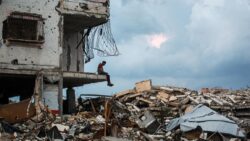
The ceasefire that came into effect on October 10 did not open a gateway to safety for Gaza’s residents as much as it marked a truce suspended on the edge of danger. As the sounds of bombardment faded, thousands of displaced Palestinians found themselves with no option but to return to damaged, cracked, and collapse-prone buildings, searching for shelter from the winter cold and relentless rain after tents proved incapable of providing even the most basic level of safety.
Thus, shattered walls and ceilings dangling with exposed steel bars and concrete blocks were transformed into “emergency shelters” for entire families—children, infants, and the elderly among them—amid the absence of any real alternatives and the continued prevention of mobile homes (caravans) from entering Gaza, which could have eased the deepening humanitarian catastrophe.
Shelter Turned Threat
With every weather depression sweeping across the Strip, the risks multiply. Fierce winds and persistent rainfall seep into fragile walls, further weakening their already compromised structure. This grim reality was laid bare when a partial collapse of a building west of Gaza City led to the killing of one Palestinian and the injury of four others, coinciding with the flooding and destruction of thousands of tents during a powerful storm that struck the enclave.
That storm was the second in less than a week. The first had claimed the lives of 14 Palestinians—11 killed by the collapse of more than 13 damaged buildings and three due to extreme cold—while approximately 53,000 tents were fully or partially flooded or damaged, according to official data. These figures speak not merely of harsh weather, but of lives being slowly stripped away.
Civil Defense spokesperson Mahmoud Basal warned of the danger posed by the collapse of thousands of damaged buildings due to intensifying winds and rainfall, calling for urgent international intervention to allow the entry of safe shelters and warning of a looming risk of death at any moment.
Destruction Without Horizon
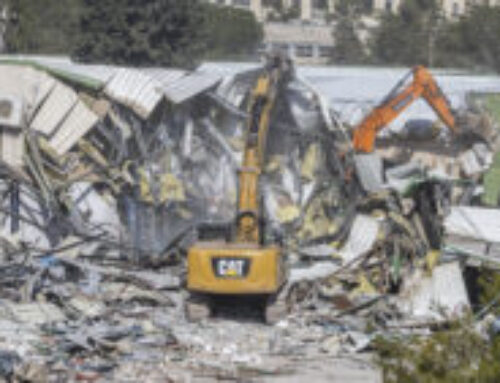
Over the two years of genocide, approximately 268,000 housing units in Gaza were completely destroyed, while 148,000 suffered severe damage rendering them uninhabitable, and another 153,000 were partially damaged, according to the latest figures from the Government Media Office in Gaza. This devastation—affecting nearly 90 percent of civilian infrastructure—has turned the prospect of returning home into a distant dream, even after the ceasefire.
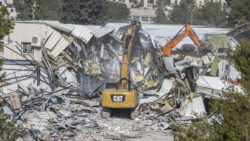
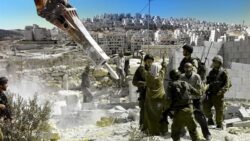
Despite the agreement, the usurping entity continues to demolish and blow up what remains of homes in areas under its control, a practice that shatters residents’ hopes of safe return and turns the truce into a heavy wait atop the ruins of houses no longer fit for life.
A Forced Choice With No Alternative
In the Hamad City residential complex in southern Gaza, Hayam Abu Nada recounts her family’s move into a damaged building after being displaced from the Shuja’iyya neighborhood. She says the lack of alternatives forced them into this choice, despite daily hearing “small collapses” inside the walls due to water leakage, adding that what remains of the structure does nothing to shield them from the cold.
Her husband, Mustafa, confirms that these buildings offer no real safety, noting that they live under constant threat of sudden collapse, while their children have fallen ill due to cold and dampness. Aouni Al-Haj, another resident, agrees, saying life in tents has become impossible and that most buildings are at risk of collapse, requiring frequent intervention by Civil Defense teams to remove hanging concrete blocks.
Fathiya Obeid, who lost her husband during the war and whose son was detained, describes these dangerous places as the “last refuge,” despite the presence of an infant living inside amid constant fear with every approaching weather system.
In western Gaza City, near the heavily destroyed Rashad Al-Shawa Cultural Center, displaced woman Halima Islim and her children live inside a tent pitched beneath the roof of a damaged building. She describes winter nights there as “constant terror,” spending sleepless hours anticipating a sudden collapse in what she once believed would be a safe haven, only to find it a source of fear.
Primitive Attempts at Survival
In Khan Younis, the family of Mohammed Al-Shaer is attempting to rebuild a room using mud and stones collected from the rubble after tents failed to protect them. The lack of cement due to the closure of crossings forced them to rely on mud, despite knowing it dissolves with rain, leaving the structure vulnerable to collapse at any moment.
Before this scene sits “Umm Imad,” who lost three of her sons and whose fourth was detained, cooking over firewood instead of gas. She says the war has pushed them “a century backward.” Between random gunfire and the threat of collapse, they live on the edge of a delayed death.
In Gaza, the war did not end with the ceasefire—it merely changed its form. It now hides in cracked walls, hanging ceilings, and the winter cold that invades bodies without warning. Thousands of families remain trapped between rubble, tents, and potential death, while the usurping entity continues to evade its obligations, foremost among them opening crossings and allowing the entry of nearly 300,000 tents and mobile homes.
Here, danger is no longer measured by the sound of explosions, but by the silence of collapse. As residents await serious international intervention, they continue to live a cruel equation: surviving one more day inside homes unfit for life—yet, for now, the only option left for survival.