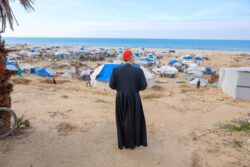
In a land still gathering what remains of its breath after a devastating war of annihilation, a Christmas candle rose inside the Holy Family Church in Gaza—a small window of light declaring not only a religious season, but the very will to live. In the heart of a city exhausted by destruction, siege, and attempts at displacement, the Christmas Mass became an act of resilience, a message that the people of Gaza—of all denominations and faiths—are rooted in their land no matter how deep the darkness grows.
This celebration was far more than a ritual. The church, which sheltered dozens of displaced families—Muslims and Christians alike—during the assault and whose outer facilities suffered heavy damage, reopened its doors to a modest congregation for the first communal prayer since the ceasefire took effect. It was as though the place—surrounded for months by shelling, explosions, shattered glass, and cracked walls—chose to resist in its own way: a quiet, solemn stand affirming that the spirit does not die.
A Visit Rekindling the Bond Between Gaza and Al-Quds
Before the candle was lit, a pastoral visit helped restore the spiritual link between Gaza and Al-Quds. The three-day visit included inspecting humanitarian projects and meeting parish members—a clear reminder that absence had not broken the bond, and that Gaza is not a distant margin in the Christian presence, but an inseparable part of a single spiritual body. Children welcomed the delegation with simple Christmas hymns, returning a measure of joy to a place surrounded by rubble and bitterness.
The words expressed during the visit carried a different weight this time. There seemed to be a small space for relief within the harsh scene, a sense that hope still finds its way through children, schools, and community activities. A message from the heart of Gaza to the world: there is still a people here clinging to life—not to what remains of the stone, but to what remains in the soul.
A Christmas That Redefines Existence
During the Mass, a central idea emerged: the present moment is not merely an attempt to survive the war, but the beginning of rebuilding life itself. Christmas—laden with symbols of light, mercy, and tenderness—became a mirror of Gaza’s reality today. The story of Christ’s birth under harsh conditions, without shelter, resembles the plight of Gaza’s residents who face winter’s cold, the loss of homes, and the absence of a roof—yet continue to hold fast to what people create with their choices and steadfastness, not what is imposed by force and empires.
This spirit reflected a conviction that reconstruction does not begin with stones, schools, or houses, but with healing hearts first. As said during the Mass, love alone can rebuild what war has destroyed and safeguard what remains of a city barely breathing yet refusing to die.
Although Christians in Gaza number only a few hundred, their presence appeared deeply rooted, steadfast, and unyielding—not marginal, but an essential part of the city’s life. Their message—interwoven with that of Muslims in the same place—stated that Gaza is one, transcending sects, and that resilience is the shared identity.
Unity of Pain… Unity of Message
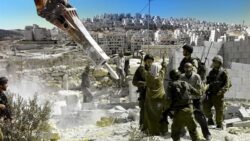
The Mass was not detached from Gaza’s broader wounds. A joint statement by several clergy members did not merely describe suffering; it extended it to include Gaza and the West Bank alike—assassinations, arrests, home demolitions, land confiscation, and settler attacks. It reminded that true celebration does not come with the disappearance of pain, but with the insistence on living despite it. “Light will prevail in the end,” the single cited phrase, carried the weight of an entire context—of injustice and the anticipation of long-delayed justice that must one day arrive.
A Church of Stone… A People of Light
The Holy Family Church in Gaza was not merely a building that survived the bombardment. It was a refuge, a home for survivors, and a witness to moments of fear, hunger, and cold. Its surroundings—unsafe for months—once again welcomed families and children, not only for ritual, but as an assertion that the place is still alive.
Amid every detail of war—from cracked walls to shattered windows to shrapnel falling near worshippers—a pulse remained, whispering that bombardment cannot erase human presence. Those who sought shelter in the church—Muslims and Christians together—embodied a genuine unity needing no slogans, a unity written in shared pain and a simple truth: to be human first.
In this sense, the Christmas Mass in Gaza was not merely a religious rite but a testimony to a city refusing to break. A single candle lit inside the Holy Family Church became more than a religious symbol; it became a declaration that Gaza—its Christians and its Muslims—lives despite the war, resists despite the siege, and lights its flame against the darkness. A Christmas that affirms life is stronger than the rubble, and that the belief in endurance is the first step toward triumph over death.