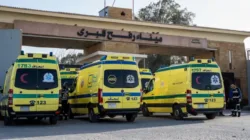
In Gaza, death is no longer the end of suffering — it has become its new beginning. Here, where souls are expected to rest and memory preserved under modest stone markers, the war extended even to the cemeteries, turning the last traces of life into open wounds. The earth that once offered safety now stands threatened — bulldozed, crushed, and uprooted — while the living watch with a pain deeper than death itself.
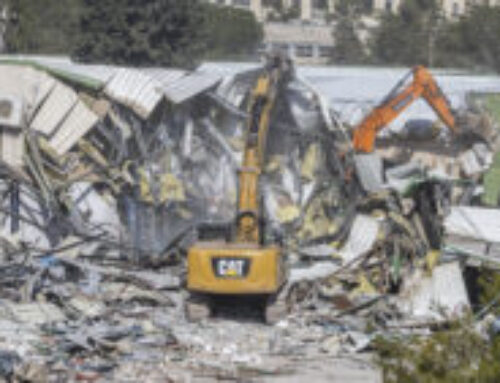
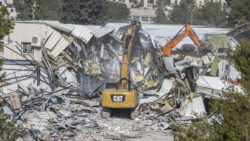
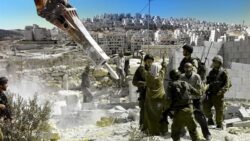
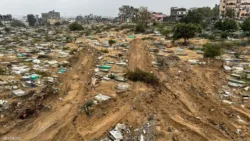
Days have revealed one of the most complex tragedies accompanying the genocidal war on Gaza: the targeting of burial grounds and funerary sites. According to the Ministry of Awqaf and rights organizations, thousands of graves have been bulldozed or destroyed by airstrikes, tanks, and heavy machinery. Satellite imagery shows extensive damage to at least sixteen major cemeteries, including historic and internationally significant sites as well as graveyards in refugee camps and densely populated areas.
The war machine did not stop at flattening graves and tearing down headstones — several cemeteries were turned into military positions or logistical corridors during ground incursions. Burial fields were carved through, pathways opened, and soil once symbolizing serenity became stamped with the tracks of armored vehicles.
Under the pretext of searching for “tunnels” or remains of “hostages,” as “Israel” claims, field testimonies and legal reports indicate grave digging and exhumation of remains, documented through footage and rights-based investigations. The result is a collapse of Gaza’s burial infrastructure, forcing families to bury their loved ones in schoolyards and public gardens, while thousands of bodies remain trapped beneath rubble amid ongoing military operations.
“Even Her Grave… They Took”
At the heart of this larger scene stands Sabreen Ba’lousha, a mother who lost her only daughter, Lin, and whose story reflects the wider agony. She recounts in a fading voice how she buried her child in Al-Batsh Cemetery, stood for hours at her grave promising to return with prayers and flowers — until the ground invasion changed everything.
Weeks later, she returned only to find nothing — no grave, no markers, not even familiar earth. “I dug with my bare hands,” she says, “calling her name until my voice broke.” Sabreen did not just lose her daughter — she lost her daughter’s last place, her address in this world, the illusion that death might offer some gentleness.
Today, she sleeps in a tent beside a school shelter, clutching her chest as though her daughter’s tiny fingers were still interlocked there. When asked what remains for her, she answers: “They left me nothing… even the grave where I cried for her was stolen.”
Her story is not an isolated one — it is a distilled image of a broader reality where the dead, too, have become victims of war, and the living suffer twice: first in loss, and again in the violation of memory and burial.
A Dual Crime
Amir Abu al-Amreen, Director General of the Ministry of Awqaf in Gaza, describes the situation as a compound crime affecting both the living and the dead. He confirms that the usurping entity controls nearly one-third of Gaza’s cemeteries, including three major burial grounds under full military control. The largest cemetery — over 300 dunums — has been closed since the first days of the war, while burials east of Salah al-Din Road are completely prohibited.
He reveals that Sheikh Radwan Cemetery — sealed for three decades — was directly bombed, graves dug up, and bodies exhumed. He accuses the occupation of stealing corpses, preventing burials, and leaving bodies in the streets “to be eaten by animals,” noting that tens of thousands of martyrs remain beneath destroyed homes without any possibility of retrieval or burial.
Rights organizations classify these violations as a clear breach of international humanitarian law, which protects burial grounds unless they are legitimate military targets. With repeated grave leveling and unlawful exhumations, observers believe the actions may amount to war crimes.
In conclusion, in Gaza today, burying the dead is no longer a ritual closure — it is another battleground with the usurping entity. Here, the dead are denied the dignity of resting in peace, and the living are wronged twice — in their loss and in the erasure of the place they grieve.
With the absence of international accountability, cemeteries have become open arenas of military abuse — as if memory itself were being erased. Yet amid waiting for justice, Gazans continue to defend their dead as they defended their living — with endurance, with attachment to the land, and with a belief that memory cannot be bulldozed no matter how deep the tracks of war cut through it.