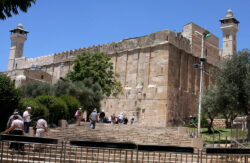
The Ibrahimi Mosque in Al-Khalil stretches like a wall of memory, bearing centuries of history and spiritual presence. Yet today, it is enduring one of its harshest phases in decades. This sacred site — once a convergence of devotion and timeless serenity — has been turned into an open arena for escalating violations and calculated attempts to reshape its religious, historical, and administrative identity. Specialists describe this as a “systematic assault” aimed at stripping the mosque of its Arab and Islamic roots.
A Reality Being Engineered by Force
Mataz Abu Sunaina, Director of the Ibrahimi Mosque, summarizes the scene by asserting that these violations are no longer isolated incidents but a deliberate policy designed to impose a new reality within the mosque and its surroundings. Daily incursions — by “Israeli” soldiers and settlers alike — are justified under so-called “security” claims, while their true aim, he says, is to enforce full control over the sanctuary.
The aggression transcends mere entry; the usurping entity repeatedly shuts the mosque’s gates before Muslim worshippers for hours, sometimes entire days, especially during Jewish religious events — a clear violation of freedom of worship. Those allowed in face humiliating restrictions and highly invasive searches, all meant to reduce Muslim presence and empty the space of its authentic spirit.
Engineering the Space… and Engineering the Presence
The distortion does not stop at the prayer halls; it extends deeply into the surrounding urban space. Abu Sunaina reveals ongoing Judaization projects — excavation, alterations to historic pathways, and the construction of settler-only passages. The Palestinian Restoration Committee is barred from even basic maintenance, while settler institutions are permitted to carry out repairs and modifications inside the areas already seized.
The most alarming measures — according to him — target the mosque’s acoustic identity. Disrupting or lowering the call to prayer has become a repeated practice dozens of times monthly, in an attempt to erase the Islamic presence and convert the site into a space dominated exclusively by Jewish ritual sound.
Physical assaults against worshippers have also intensified — pushing, beating, arrests, and denial of entry, especially during dawn prayers. Abu Sunaina views this as part of an attempt to impose a full temporal division, mirroring what occurs at Al-Aqsa Mosque, followed by a broader spatial partition to seize more sections of the Ibrahimi Mosque since the 1994 massacre.
From Al-Khalil to Al-Quds… Violations of the Same Pattern
Palestine’s Grand Mufti, Sheikh Muhammad Hussein, affirms that what is happening in Al-Khalil is not an isolated case but part of a wider policy targeting Islamic and Christian holy sites, foremost among them Al-Aqsa Mosque. According to him, “Israel” deploys several tools — banning worshippers, erecting metal barriers, restricting restoration works, and tightening surveillance — all as part of a calculated effort to alter the Arab-Palestinian character of these sacred cities.
The Mufti describes the measures as a deliberate religious partition that began years ago and is taking on sharper form today. For him, the Ibrahimi Mosque is not merely a place of prayer — it is a central pillar of Palestinian identity in Al-Khalil, deeply intertwined with belonging, heritage, and existence.
Silence as Permission
Abu Sunaina and the Mufti both warn that the absence of international pressure emboldens the usurping entity to escalate its actions, reinforcing the belief that the mosque is left wide open to its Judaization schemes. Calls are growing for reactivating the role of global heritage institutions, chiefly UNESCO, to protect what remains of the mosque’s identity and prevent the erasure of its Islamic features.
Yet the Mufti goes further, stressing that statements alone are no longer sufficient, and that religious and national responsibility demands the continuous Palestinian presence in the mosque — a front-line defense in a struggle that is not merely about rituals but about existence, memory, and history.
In Al-Khalil, it is not only the call to prayer that echoes — history itself cries out not to be erased. Today, the Ibrahimi Mosque stands between two voices: one attempting to construct an artificial presence at the expense of authenticity, and one Palestinian voice insisting on remaining — even under iron gates, cameras, and intimidation.
It is not a new battle. Across centuries, the mosque has stood as a witness to an enduring contest over identity. Now, it faces yet another chapter, waiting for the world to see — and for the Palestinian to endure — because what is at stake is not the fall of a mosque, but the fall of an entire memory of the city.