Amid the rubble of war and the hardship of daily life, where banknotes wear away just as the details of living do, Manal Al-Sa‘dani sets up her small table every morning as if pitching a tent of hope over the ruins of the siege. this mobile table has turned into a traveling workshop for repairing worn-out currency in the Gaza Strip, where no new banknotes have entered since the outbreak of the war more than two years ago.
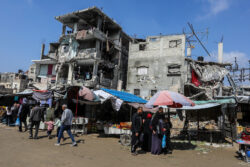
Manal carries her table from Al-Bureij refugee camp to the Nuseirat market in the central Gaza Strip. she walks among the debris to turn the edge of the market into a workspace from which she secures her daily sustenance and that of her daughters. with simple tools—a scalpel blade, a little glue, and a glass board—she begins the rescue mission of torn paper from rejection and decay.
“I decided to work and started repairing banknotes… people in the street supported me a lot,” Manal says as she moves from one customer to another. they hand her damaged twenty-shekel notes, which she repairs in exchange for one or two shekels. the shekel, the main currency in circulation, has become scarcer than ever after the occupation tightened its siege and prevented the entry of money into Gaza.
Damaged Money… Rejected by Markets
The banknotes circulating today in a sector devastated by war and where most of the population has been forcibly displaced have reached a condition that leads many shop owners to refuse them. Manal takes the cracked note, carefully injects glue into its splits, smooths it with her fingers, then lifts it toward the light to examine what remains of its paper life.
when a note reaches a point beyond repair, Manal jokes with her customers: “take these and go buy some biscuits,” returning two twenty-shekel notes that can no longer be saved.
customer Nabila Jannar says that most of the notes are damaged and that merchants refuse them, forcing people to have them repaired in exchange for two shekels for twenty and three shekels for a fifty. she adds with bitterness, “they have to find a solution… money itself has become a problem.”
Colors that Return Life to Paper
Manal uses colored chalk to restore a touch of brightness to the notes: red for the twenties, green for the fifties, orange for the hundreds, and blue for the two hundreds. with these colors, she tries to give the worn paper some sense of “usability” in a market that has lost the most basic conditions of sound circulation.
but behind this daily effort stands a mother exhausted by fatigue. Manal sighs, saying: “because I am a woman, everyone stands by me and supports me… but I am tired. don’t I have the right to rest one day beside my daughters instead of this suffering?”
A Cash Crisis Paralyzing the Economy
The cash crisis in Gaza is no longer a passing detail in people’s lives; it has become one of the most prominent manifestations of economic paralysis. the same banknotes are now sold with a commission that can reach 34 percent because of their scarcity, while the markets suffer a severe shortage of small change and coins relied upon by vendors, transportation, and daily transactions.
international reports confirm the depth of the economic catastrophe. the United Nations has indicated that the war has set Gaza back seventy years in terms of human development, while the World Bank revealed that 93 percent of bank branches operating in the Strip have been destroyed, along with most microfinance institutions and insurance companies.
An Economy on The Brink of Division
Economists believe that the continuation of this situation threatens to create a distorted dual economy inside the Strip: one cash-based, built on damaged currency, and another limited electronic economy that by itself cannot shoulder the burdens of a full life under siege.
Despite the expansion of electronic payment platforms in recent years, traders confirm that Gaza’s markets remain in urgent need of direct cash dealings in light of electricity outages, communication disruptions, and the high cost of alternatives.
Manal… Another Image of Resistance
Between the cracks of the banknotes Manal glues together, another story of silent resilience in Gaza seeps through. she is not a fighter on the battlefield, but she resists through work, through the flour she buys with the wage of repairing a single note, and through the bread she carries to her daughters at the end of the day.
In Gaza, where everything is repaired by necessity—even money—the fingers of a simple mother are transformed into a tool of rescue in the battle for survival.