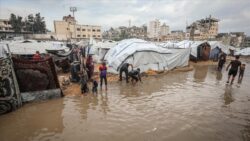
The rain in the Mawasi area of Khan Younis was not a passing event, but a harsh test of endurance. There, where rows of worn and overcrowded displacement tents stretch endlessly along muddy roads, the rain began pounding the thin fabric roofs at nightfall, turning the sound into an early warning of a long, heavy night. It was not the music of rain, but a rhythm of fear, growing with every drop, reminding residents that their temporary shelter could collapse at any moment — and that survival itself had become an act of resistance.
A Tent on the Brink of Collapse
Inside one of these tents stood Mahmoud Al-Haddad, in his mid-thirties, watching water seep through every corner of the tattered roof. Simple yet crushing questions echoed in his mind: How could he save what little remained of his family’s belongings? How could he protect his two children from the merciless cold? Around him, the camp moved in fragile unison — women tightening worn ropes, children sitting on soaked ground watching water advance into their shelters, and tents swaying as if breathing in fear.
With every passing hour of rain, the tents lost more of their ability to withstand the storm. Mahmoud’s tent, erected as a temporary refuge after his home was destroyed in the war, faced a relentless trial. By midnight, water had pooled beneath mattresses and clothes. He tried to lift whatever he could, but the flow was faster than his efforts. When his sons, Hamza and Islam, began shivering from the cold, water was pouring in from every direction. Mahmoud recalls feeling as though the world was collapsing all at once. Within minutes, the tent’s rear support gave way under the pressure, and the family’s living space turned into a pool of mud.
The Morning After the Storm
At dawn, the camp looked as though it had narrowly survived a small disaster: collapsed tents, torn plastic sheets, and the smell of damp fabric mixed with fuel used for heating. The loss was not merely material, but symbolic. Children’s notebooks, drawings, and school assignments had been soaked. “The hardest moment was when I saw the notebooks,” Mahmoud says in a weary voice. “Even the simplest things they had were gone.”
This personal scene reflects a far wider tragedy. In another tent, an infant lost her life due to the severe cold caused by the low-pressure system. The Ministry of Health confirmed the death of the child, Rahaf Abu Jazar, highlighting the extreme fragility of living and health conditions inside the camps. Within just 24 hours, the Civil Defense received more than 2,500 emergency calls, according to its spokesperson Mahmoud Basal, who warned of “catastrophic consequences” as the storm peaked. He stressed that available resources do not meet even the minimum needs, and that tents are not a humanitarian solution but rather a factor that deepens the suffering of displaced families.
Figures That Reveal the Depth of the Crisis
Across the Gaza Strip, Civil Defense teams reported the collapse of a three-story home in northern Gaza, as well as the flooding of entire displacement camps in Mawasi Khan Younis, areas of Deir al-Balah and Nuseirat, and neighborhoods in Gaza City. Over a 12-hour period, 32 operations were carried out, including responses to flooded tents, evacuations, and water pumping.
Estimates indicate that around 250,000 families are living in displacement camps suffering from a severe shortage of adequate tents and shelters. According to the Government Media Office, most existing tents are no longer fit for habitation. The need exceeds 300,000 new tents, while 93 percent of current shelters — approximately 125,000 out of 135,000 — are uninhabitable.
Attempts at Endurance
Despite everything, Mahmoud did not give up. With the help of neighbors, he lifted the tent’s poles once again, gathering torn plastic sheets and old wooden pieces to erect a shelter that barely offered protection. His children, like thousands of others in the camps, live daily between cold, water, and mud. Their play has become an attempt to find a dry patch of ground.
With a sad smile, Mahmoud sums up his demand: “We’re not asking for comfort… just a roof that protects the children from the rain, and one night where we can sleep without fear.”
Mahmoud’s story is not an exception, but a recurring chapter in Gaza’s displacement reality. Here, a rainy night turns into a battle for survival, and a tent becomes a test of dignity before it is a shelter. Between flooded tents, destroyed homes, and collapsed services, people wait for any sign of relief — a usable tent, a mobile home, or a humanitarian decision that redefines protection. Until then, rain in Gaza will remain more than weather; it will remain an open question about a basic right to safety, postponed with every storm.